How to Save $1,000 Fast: 17 Realistic Methods That Actually Work
Introduction: Saving $1,000 Is Not Easy, But It Is Possible
Saving $1,000 can feel impossible when money is already tight.
You may have rent, food, transport, debt, family responsibilities, subscriptions, bills, and unexpected expenses pulling at your income before you even get a chance to save. By the time the month ends, there may be almost nothing left.
That is why most people fail at saving.
They try to save whatever remains.
But if you want to learn how to save $1,000 fast, you cannot depend on leftovers. You need a direct plan. You need to decide how much to save, how quickly you want to save it, which expenses to cut, and how to bring in extra money if your income is too low.
The good news is that saving $1,000 does not require magic. It requires a system.
This article will show you realistic, practical methods you can use to save $1,000 faster, even if you are starting from zero.
This is not about extreme sacrifice. It is about focused action. For a detailed information about saving $1000 fast please read “The Total Money Makeover” by Dave Ramsey
Why Saving $1,000 Matters
Before you save $1,000, you need to understand why it matters.
A $1,000 savings fund can protect you from many common financial problems. It may not make you rich, but it can stop one emergency from destroying your budget.
With $1,000 saved, you may be able to handle:
- A medical bill
- Car repair
- Phone repair
- Emergency travel
- A missed paycheck
- School-related costs
- Urgent home expenses
- Temporary job loss
- Unexpected family support
The real value of $1,000 is not only the money. It is the breathing room.
When you have no savings, every problem feels like a crisis. You borrow, delay payments, panic, or use debt. But when you have money set aside, you gain options.
That is why learning how to save $1,000 fast is one of the best first steps toward financial stability.
How Fast Can You Realistically Save $1,000?
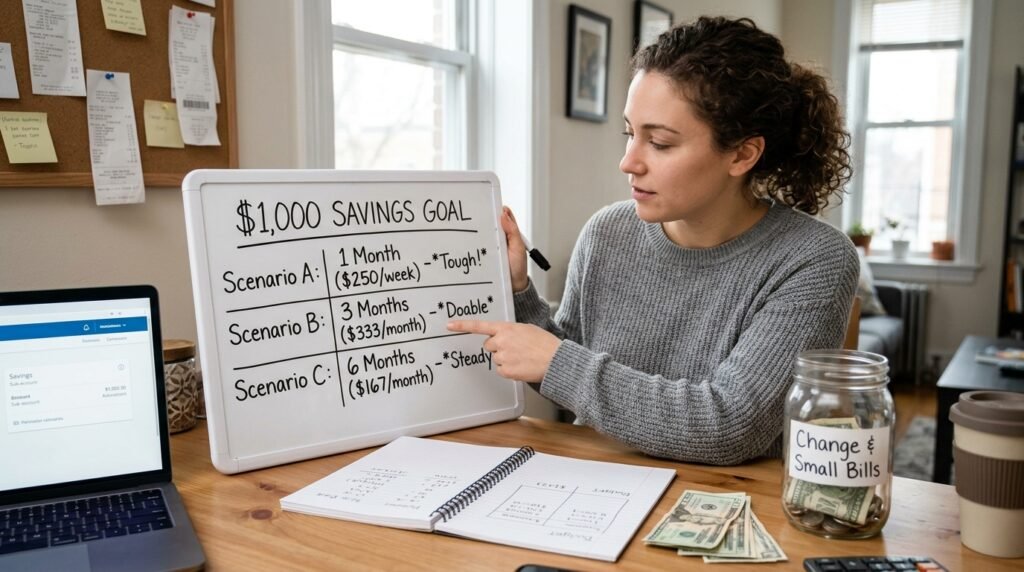
The timeline depends on your income, expenses, and how aggressive you are willing to be.
Here are simple examples:
- Save $250 per month → $1,000 in 4 months
- Save $200 per month → $1,000 in 5 months
- Save $125 per week → $1,000 in 8 weeks
- Save $100 per week → $1,000 in 10 weeks
- Save $50 per week → $1,000 in 20 weeks
If your income is low, the fastest path may require both expense cuts and extra income.
For example:
- Cut $150 per month from spending
- Earn an extra $150 per month
- Save $300 per month total
- Reach $1,000 in about 3–4 months
That is more realistic than trying to cut $300 from an already tight budget.
The key is this:
Do not rely on one method. Combine several small methods until they add up.
That is how you save $1,000 fast without destroying your life.
1. Set a Clear $1,000 Deadline
The first mistake is saying, “I want to save $1,000.”
That is not a plan. It is a wish.
You need a deadline.
For example:
- Save $1,000 in 90 days
- Save $1,000 in 4 months
- Save $1,000 before the end of the year
- Save $1,000 before moving, traveling, investing, or starting school
A deadline forces you to calculate the weekly target.
If you want to save $1,000 in 10 weeks, you need to save $100 per week.
If you want to save $1,000 in 20 weeks, you need to save $50 per week.
This gives your goal structure.
Write the goal clearly:
“I will save $1,000 by [date] by saving $___ per week.”
This is important because a target without a weekly number is easy to ignore.
2. Break the $1,000 Goal Into Smaller Milestones
Saving $1,000 sounds large. Breaking it into smaller milestones makes it easier.
Use this structure:
- First milestone: $100
- Second milestone: $250
- Third milestone: $500
- Fourth milestone: $750
- Final milestone: $1,000
Do not wait until you reach $1,000 to feel progress. Celebrate each milestone quietly and keep moving.
The first $100 is the most important because it proves that saving is possible.
The first $250 builds confidence.
The first $500 gives you real protection.
The final $1,000 gives you a proper emergency buffer.
If you are trying to learn how to save $1,000 fast, this milestone method keeps you motivated because the goal feels less overwhelming.
3. Open a Separate Savings Account or Wallet
If your $1,000 sits in the same place as your spending money, you will probably touch it.
That is not because you are weak. It is because the money is too easy to access.
To save $1,000 fast, separate your savings from your everyday cash.
You can use:
- A separate bank account
- A savings wallet
- A mobile money savings account
- A cash envelope
- A locked savings feature
- A trusted savings group, if reliable and safe
The goal is to create distance.
Your savings should be accessible in a real emergency, but not easy enough to spend casually.
A simple rule:
Spending money should be convenient. Savings should be protected.
If you keep everything together, you will keep borrowing from yourself.
4. Save First Every Time Money Comes In
Most people save backward.
They receive income, spend on bills and lifestyle, then try to save what is left. The problem is that nothing is usually left.
To save $1,000 fast, reverse the order.
Every time money comes in, save first.
If you earn weekly, save weekly.
If you earn monthly, save immediately when paid.
If your income is irregular, save a percentage from every payment.
Example:
- You receive $100 → save $10
- You receive $250 → save $25
- You receive $500 → save $50
This works because saving becomes automatic behavior, not an afterthought.
If your income is unstable, use a percentage rule:
Save 10% of every income payment until you reach $1,000.
If 10% is too high, start with 5%. If 5% is difficult, start with 2%. The first goal is consistency.
5. Do a 7-Day Spending Audit
You cannot save money quickly if you do not know where your money is leaking.
For seven days, track every expense.
Write down:
- What you bought
- How much it cost
- Whether it was planned
- Whether it was necessary
- How you felt when you bought it
This last part matters. Many purchases are emotional.
At the end of seven days, look for repeated spending.
Common leaks include:
- Snacks
- Drinks
- Takeout
- Delivery fees
- Transport upgrades
- Subscriptions
- Impulse purchases
- Small online orders
- Convenience charges
- Bank or transfer fees
You are not looking for one dramatic expense. You are looking for patterns.
If you find $25 per week in waste, that is $100 per month.
If you find $50 per week in waste, that is $200 per month.
That alone can move you toward $1,000.
If your income is low and you need a complete saving structure, read how to save money fast on a low income.
6. Cut One Big Expense Temporarily
Small cuts help. But one big temporary cut can speed up the process.
Look for one expense you can reduce or pause for 30–90 days.
Examples:
- Pause a subscription bundle
- Reduce eating out
- Cancel unused memberships
- Downgrade phone or data plan
- Stop buying new clothes temporarily
- Reduce entertainment spending
- Delay non-essential purchases
- Limit paid outings
This does not have to be permanent.
That is the key.
You are not saying, “I will never enjoy life again.”
You are saying, “For the next 90 days, my priority is saving $1,000.”
Temporary sacrifice is easier than permanent restriction.
If cutting one large expense saves $100 per month, you are already 10% of the way there.
You can read more at https://www.investor.gov/introduction-investing/investing-basics/save-and-invest
7. Use a 30-Day No-Spend Challenge
A no-spend challenge is one of the fastest ways to create savings.
For 30 days, you only spend on essentials.
Allowed spending:
- Rent
- Food
- Transport
- Utilities
- Medication
- Debt payments
- Work or school needs
- Basic family responsibilities
Paused spending:
- New clothes
- Eating out
- Paid entertainment
- Random shopping
- Upgrades
- Subscriptions you do not need
- Impulse purchases
The goal is not perfection. The goal is awareness and control.
If a full 30-day challenge feels too strict, try:
- No-spend weekdays
- No-spend weekends
- No eating out for 30 days
- No online shopping for 30 days
- No paid entertainment for 30 days
A no-spend challenge works because it interrupts autopilot spending.
If you save $150 during the challenge, put the full amount directly into your $1,000 fund.
8. Reduce Food Spending Without Eating Poorly
Food is one of the most flexible budget categories, but you must be careful.
Do not cut food in a way that damages your health. That is foolish.
Instead, reduce waste and convenience.
Practical ways to reduce food spending:
- Plan meals before shopping
- Buy basic ingredients
- Cook more often
- Carry lunch instead of buying it
- Reduce snacks and sugary drinks
- Use leftovers
- Buy in bulk only when it saves money
- Avoid shopping while hungry
- Compare prices before buying
- Limit food delivery
Food delivery and takeout are often silent budget killers.
Example:
If you spend $8 on lunch five times a week, that is $40 per week.
If you reduce that to $20 per week by preparing meals, you save $20 weekly.
That is about $80 per month.
Over three months, that is $240.
That is almost one-quarter of your $1,000 goal from one category.
9. Control Transport Costs
Transport costs can quietly drain your money, especially if you are always moving without planning.
Look for ways to reduce unnecessary trips or expensive routes.
Ask:
- Can I combine errands into one trip?
- Can I walk short distances safely?
- Can I use a cheaper route?
- Can I share transport costs?
- Can I avoid last-minute expensive transport?
- Can I plan earlier to avoid paying more?
Poor planning often creates transport waste.
If you are always late, you may spend more on faster transport. If you run errands one by one, you may pay for unnecessary trips.
Even saving $10 per week on transport gives you $40 per month.
That is $120 in three months.
Again, this is how you save $1,000 fast: not from one magic trick, but from stacking small wins.
10. Sell Things You Do Not Use
If you need to save quickly, selling unused items can give you a strong head start.
Look around your home.
You may have:
- Old phones
- Shoes
- Clothes
- Bags
- Electronics
- Books
- Furniture
- Kitchen items
- Tools
- Fitness equipment
- Accessories
Many people have cash sitting in objects they no longer use.
Make a list of items you can sell.
Then price them realistically.
Do not overprice everything and wait forever. The goal is to build your $1,000 fund, not prove that your old item is worth what you originally paid.
If you can sell five items for $20 each, that is $100.
If you sell a phone, laptop, furniture, or appliance, you may raise much more.
Important rule:
Every dollar from selling unused items goes directly into the $1,000 savings fund.
Do not sell things and then spend the money casually. That defeats the purpose.
11. Take a Temporary Side Gig
If your income is too tight, cutting expenses may not be enough.
You may need extra income.
This is where many people get distracted. They start looking for the perfect side hustle instead of the fastest practical cash.
You do not need a perfect business. You need a temporary cash boost.
Possible short-term income ideas:
- Cleaning
- Tutoring
- Delivery
- Errands
- Babysitting
- Freelance writing
- Graphic design
- Video editing
- Selling food
- Virtual assistant work
- Social media support
- Weekend work
- Repair services
- Reselling items
- Helping someone organize or move
Choose something realistic based on your skills, location, and available time.
If you earn an extra $50 per week, you can save $1,000 in 20 weeks from the side gig alone.
If you earn $100 per week, you can save $1,000 in 10 weeks.
Combine that with expense cuts, and the timeline becomes much faster.
12. Use the “Half of Extra Money” Rule
Whenever unexpected money comes in, save at least half.
This includes:
- Bonuses
- Gifts
- Refunds
- Extra work income
- Overtime pay
- Money from selling items
- Cash gifts
- Tax refunds
- Commissions
The mistake people make is treating extra money as free spending money.
That keeps them broke.
Instead, use this rule:
Save 50% of all unexpected money until you reach $1,000.
If you receive $100 unexpectedly, save $50.
If you receive $300, save $150.
If you receive $500, save $250.
This rule allows you to enjoy some of the money while still making progress.
If you are serious and want to move faster, save 80–100% of all extra money until you reach the goal.
13. Pause Non-Essential Shopping
Most people underestimate how much random shopping costs them.
This includes:
- Clothes
- Shoes
- Home decor
- Gadgets
- Accessories
- Beauty products
- Online deals
- Small upgrades
- “Just because” purchases
The problem with shopping is that it often feels justified.
You tell yourself:
- “It was on sale.”
- “I deserve it.”
- “It was only a small amount.”
- “I need to look good.”
- “I’ll save next week.”
That thinking delays your goal.
For the next 60–90 days, pause non-essential shopping.
Use what you already have.
Before buying anything non-essential, ask:
- Can this wait until after I save $1,000?
- Do I already own something similar?
- Is this urgent or emotional?
- Will this purchase matter in 30 days?
A delay is not a denial. You can buy later if it still matters.
But right now, the goal is $1,000.
14. Lower Your Bills Where Possible
Some bills are fixed, but others can be negotiated, reduced, or replaced.
Review:
- Phone plan
- Internet plan
- Subscriptions
- Insurance
- Utilities
- Bank fees
- Loan fees
- App memberships
Ask:
- Am I using this enough to keep paying?
- Is there a cheaper plan?
- Can I cancel this temporarily?
- Can I switch providers?
- Can I negotiate?
- Can I share the cost with someone?
Many people keep paying for services they barely use because canceling feels like work.
That laziness is expensive.
Even reducing bills by $30 per month gives you $360 per year.
If you reduce bills by $100 per month, you can reach $1,000 much faster.
15. Use Cash Limits for Flexible Spending
If you overspend with cards or mobile payments, use cash limits.
This is simple.
Decide how much you can spend weekly on flexible expenses. Then separate that amount.
Example:
- Weekly flexible spending limit: $40
- Put $40 in cash or a separate wallet
- When it is gone, spending stops
This creates a physical boundary.
Digital money often feels invisible. Cash makes spending more real.
You can also use separate digital wallets or accounts if cash is not practical.
The point is to prevent flexible spending from invading your savings goal.
For people who struggle with impulse spending, this method is powerful.
16. Make Your Savings Visible
Invisible goals are easy to ignore.
Make your $1,000 goal visible.
Use:
- A savings tracker
- A notebook chart
- A progress bar
- A wall calendar
- A phone note
- A spreadsheet
- A printable checklist
Break the goal into 10 boxes of $100 each.
Every time you save $100, mark one box.
This may seem simple, but visible progress increases motivation.
Saving is emotional. If you do not see progress, you may feel like nothing is happening.
A tracker reminds you that every small deposit matters.
17. Protect the $1,000 Once You Save It
Saving $1,000 is one thing. Keeping it is another.
Once you reach $1,000, do not treat it like spending money.
This is your emergency fund.
Use it only for true emergencies.
Not emergencies:
- New clothes
- Random shopping
- Eating out
- Holidays
- Phones you do not need
- Social pressure
- Entertainment
- “I’ll replace it later” purchases
Real emergencies:
- Medical needs
- Urgent repairs
- Essential bills during income disruption
- Necessary travel
- Job-related emergency costs
If you use part of the fund, rebuild it immediately.
Your $1,000 is not the finish line. It is the foundation.
After reaching your first $1,000, read the emergency fund guide to know how much you should build next.
A Practical 90-Day Plan to Save $1,000
Here is a realistic plan.
Month 1: Create the First $300
Goal: Save $300.
Actions:
- Save first from every income payment
- Do a 7-day spending audit
- Cut one recurring expense
- Sell unused items
- Reduce food spending
- Start a no-spend weekend
Possible result:
- $100 from spending cuts
- $100 from selling items
- $100 from income savings
Total: $300
Month 2: Push to $650
Goal: Add $350.
Actions:
- Continue saving first
- Add temporary side income
- Reduce transport waste
- Pause non-essential shopping
- Save half of extra money
Possible result:
- $150 from expense cuts
- $150 from side income
- $50 from extra money
Total saved: $650
Month 3: Reach $1,000
Goal: Add final $350.
Actions:
- Keep food and transport cuts
- Complete another no-spend challenge
- Save extra income
- Lower one bill
- Avoid new debt
Possible result:
- $100 from spending cuts
- $150 from side income
- $100 from extra payments or bill reduction
Total: $1,000
This plan is not perfect, but it is realistic. You can adjust the numbers based on your situation.
The key is to combine methods.
What If You Cannot Save $1,000 Fast?
Be honest.
If your income is extremely low and your expenses are high, saving $1,000 quickly may be difficult. That does not mean you should give up.
Start smaller.
Aim for:
- $100 first
- Then $250
- Then $500
- Then $1,000
A slower plan is still a plan.
The worst option is doing nothing because $1,000 feels too far away.
If you can only save $10 per week, start there. That becomes $520 in a year. If you increase it later, you will move faster.
The person who saves slowly is still ahead of the person who keeps starting from zero.
Common Mistakes to Avoid When Saving $1,000
Mistake 1: Trying to Cut Everything at Once
Extreme restriction usually fails.
Cut strategically, not emotionally.
Mistake 2: Keeping Savings Too Accessible
If it is too easy to spend, you will spend it.
Separate the money.
Mistake 3: Not Tracking Spending
You cannot fix what you refuse to measure.
Mistake 4: Depending Only on Motivation
Motivation fades. Systems remain.
Mistake 5: Saving Without a Deadline
No deadline means no urgency.
Mistake 6: Ignoring Income
Sometimes the issue is not spending. Sometimes you need more income.
Mistake 7: Using the Money Too Soon
Do not destroy the emergency fund for non-emergencies.
Conclusion: Saving $1,000 Fast Requires Focus, Not Perfection
Learning how to save $1,000 fast is not about finding one secret trick. It is about building a focused system that makes saving the priority.
You need a clear deadline, a separate savings place, a weekly target, reduced spending leaks, and possibly extra income. You also need to protect the money once you save it.
The best strategy is not extreme sacrifice. It is stacking realistic actions:
- Save first
- Cut repeated expenses
- Reduce food and transport waste
- Sell unused items
- Take temporary extra work
- Pause non-essential shopping
- Save extra money
- Track your progress
- Protect the fund
If $1,000 feels too large, start with $100. Then $250. Then $500. Then keep going.
The goal is not just to save $1,000.
The goal is to prove to yourself that you can build financial control.
Once you save your first $1,000, you are no longer starting from zero. You have a buffer. You have breathing room. You have proof that your money can follow a plan.
That is where real financial progress begins.
Frequently Asked Questions
How long does it take to save $1,000 fast?
It depends on how much you can save each week. If you save $100 per week, you can reach $1,000 in about 10 weeks. If you save $250 per month, it will take about 4 months. The fastest method is to combine spending cuts, extra income, and automatic savings.
What is the easiest way to save $1,000 fast?
The easiest way is to break the goal into smaller weekly targets. Instead of focusing on $1,000, aim to save $100 per week for 10 weeks. You can reach that by cutting cash leaks, reducing food spending, selling unused items, and saving part of every paycheck.
Can I save $1,000 fast on a low income?
Yes, but you need a realistic plan. Start with small milestones like $100, $250, and $500 before reaching $1,000. Focus on reducing high-frequency expenses, avoiding new debt, selling unused items, and adding temporary side income where possible.
Where should I keep the $1,000 I save?
Keep your $1,000 in a safe and separate place such as a high yield savings account or emergency fund account that is not used for daily spending. Do not keep it mixed with your everyday spending money or you may accidentally use it.
Should I save $1,000 before paying off debt?
If you have high-interest debt, build a small emergency fund first, then focus on debt. A good starting point is $500 to $1,000 in emergency savings. This prevents you from borrowing again when unexpected expenses happen.
What expenses should I cut first to save $1,000 fast?
Start with expenses that repeat often but do not add much value. Common examples include food delivery, unused subscriptions, impulse shopping, snacks, entertainment, and convenience purchases. Cutting small repeated expenses can free up more money than you expect.
What should I do after saving my first $1,000?
Protect it as an emergency fund. Your next step should be to rebuild it if you use it, increase your emergency fund toward one month of expenses, pay down high-interest debt, and continue building better saving habits.

John F. Miller is a personal finance writer and the founder of MyCash Advice. He covers savings accounts, credit cards, budgeting strategies, and debt payoff methods. His mission is to make practical money advice accessible to everyone regardless of income level.