
How to Freeze Your Credit Without Hurting Your Credit Score.
Introduction
Freezing your credit sounds serious.
For many people, the word “freeze” creates fear. They imagine their credit score dropping, their credit cards stopping, their bank accounts locking, or future loan applications becoming impossible.
That fear is understandable, but most of it is wrong.
The direct answer is simple:
You can freeze your credit without hurting your credit score.
A credit freeze does not lower your credit score. It does not close your current credit cards. It does not stop you from using existing accounts. It does not prevent you from checking your credit report. It simply restricts access to your credit report when someone tries to open new credit in your name.
The Federal Trade Commission says a credit freeze is free to place or lift, and it does not affect your credit score. The FTC also explains that when a freeze is in place, nobody can open a new credit account in your name.
That makes a credit freeze one of the strongest free tools for protecting yourself from identity theft.
But it must be done correctly.
You need to freeze your credit with all three major credit bureaus: Equifax, Experian, and TransUnion. Freezing only one report is not enough because a lender may check a different bureau.
This guide explains how to freeze your credit safely, what happens after you freeze it, when you should lift it, and what mistakes to avoid.
Want to fully understand how your credit report works and how to protect it long term? Your Score by
Anthony Davenport is the most practical guide I have found — written specifically for people who want to
take control of their credit without the jargon.
Does Freezing Your Credit Hurt Your Credit Score?
No. Freezing your credit does not hurt your credit score.
This is the most important point.
A credit freeze is a security tool, not a negative credit event. It does not mean you failed to pay a bill. It does not mean you closed an account. It does not mean you applied for new credit. It does not change your payment history, credit utilization, age of accounts, credit mix, or other normal credit scoring factors.
The CFPB states clearly that security freezes do not impact your credit scores. The FTC also says a credit freeze will not affect your credit score or your ability to use existing credit cards.
So if your concern is:
“Will freezing my credit lower my score?”
The answer is:
No. It will not lower your credit score.
What it can do is temporarily block access to your credit report when you apply for new credit. That is the point of the freeze.
What a Credit Freeze Actually Does
A credit freeze, also called a security freeze, blocks most new creditors from accessing your credit report.
When a lender cannot access your frozen credit report, they usually cannot approve a new credit account in your name.
USA.gov explains that when you place a security freeze, creditors cannot access your credit report, which keeps them from approving any new credit account in your name, whether fraudulent or legitimate.
That is useful because many identity thieves try to open new accounts using stolen personal information.
A freeze helps block:
- Fraudulent credit card applications
- Fraudulent personal loans
- Fraudulent store credit accounts
- Some unauthorized financing attempts
- New credit accounts opened using stolen identity details
Think of it like locking the front door to your credit report.
It does not erase your credit history. It does not repair bad credit. It does not stop every type of fraud. But it makes it much harder for someone to open new credit in your name.
What a Credit Freeze Does Not Do
A credit freeze is powerful, but it is not magic.
It does not:
- Lower your credit score
- Close your existing credit cards
- Stop you from using current credit cards
- Stop existing lenders from managing your accounts
- Stop debt collectors from accessing permitted information
- Prevent all identity theft
- Stop unauthorized charges on existing accounts
- Replace credit monitoring
- Replace strong passwords
- Stop bank account fraud
- Stop tax identity theft
TransUnion explains that a credit freeze has no effect on credit cards you already own; it mainly prevents your credit report from being accessed when someone tries to open new accounts.
This matters because some people freeze their credit and think they are fully protected from every type of financial fraud.
That is false.
A credit freeze protects against new credit account fraud. It does not protect every existing account you already have.
You still need to monitor:
- Bank accounts
- Credit card transactions
- Email accounts
- Phone accounts
- Tax records
- Online shopping accounts
- Password security
A credit freeze is one layer of protection, not the entire security system.
Who Should Freeze Their Credit?
Freezing your credit can make sense for many people, not only people who have already experienced identity theft.
The FTC says you do not have to wait for your Social Security number or other information to be exposed in a data breach or misused by an identity thief to freeze your credit; anyone can do it anytime.
You should strongly consider a credit freeze if:
- Your personal information was exposed in a data breach
- You lost your wallet
- Your Social Security number may be compromised
- You received strange credit application notices
- You saw accounts you do not recognize
- You are not planning to apply for new credit soon
- You want extra protection against identity theft
- You have children and want to protect their credit files
- You are elderly or helping protect an older family member
- You have already been a victim of identity theft
You may also freeze your credit even if nothing bad has happened. That is not extreme. It is preventive.
If you rarely apply for new credit, keeping your reports frozen can be a smart default.
When You Should Not Freeze Your Credit Yet
A credit freeze is usually safe, but timing matters.
You may want to wait or prepare first if you are about to:
- Apply for a mortgage
- Apply for a car loan
- Apply for a credit card
- Apply for a personal loan
- Finance furniture, appliances, or electronics
- Open certain financial accounts
- Rent an apartment where the landlord checks credit
- Apply for utilities where credit may be checked
A freeze does not stop you from doing these things permanently. But it can slow the process if you forget to lift the freeze first.
The FTC explains that if you need to apply for new credit, you can temporarily lift the freeze to let the creditor check your credit.
So the practical rule is:
Freeze your credit when you are not actively applying for new credit. Temporarily lift it when needed.
How to Freeze Your Credit at All Three Bureaus
You must contact each credit bureau separately.
Freezing one bureau does not freeze the others.
The three major credit bureaus are:
- Equifax
- Experian
- TransUnion
You can usually freeze your credit online, by phone, or by mail.
For most people, online is fastest.
Step 1: Freeze Your Equifax Credit Report
Go to Equifax’s official credit freeze page and follow the identity verification steps. Equifax describes a security freeze as a step that can help prevent access to your Equifax credit report to open credit accounts, with certain exceptions.
You may need:
- Full legal name
- Date of birth
- Social Security number
- Address
- Contact information
- Identity verification answers
After freezing, save your login details or confirmation information.
Step 2: Freeze Your Experian Credit Report
Go to Experian’s official credit freeze page and follow the instructions. Experian confirms that a credit freeze is free and does not affect your credit score.
Again, save your login information and confirmation details.
Step 3: Freeze Your TransUnion Credit Report
Go to TransUnion’s credit freeze page. TransUnion states that credit freezes are always free and are provided by credit reporting agencies.
Save your account details after freezing.
Step 4: Confirm All Three Are Frozen
Do not assume the job is done after one bureau.
Make a simple checklist:
- Equifax: Frozen
- Experian: Frozen
- TransUnion: Frozen
If all three are not frozen, your protection is incomplete.
Practical Example: Why Freezing Only One Bureau Is Weak
Imagine someone steals your personal information and applies for a credit card in your name.
You froze your Equifax report only.
The credit card issuer checks TransUnion instead.
Because TransUnion is not frozen, the application may still be processed.
That is why freezing only one credit bureau is not enough.
A proper freeze means all three major bureaus are frozen.
This is not optional.
Can You Still Use Your Credit Cards After Freezing Your Credit?
Yes. You can still use your existing credit cards after freezing your credit.
A credit freeze does not shut down your current accounts. It does not stop current lenders from letting you use accounts that already exist.
TransUnion says a credit freeze has absolutely no effect on credit cards you already own; you can still use the credit cards you have.
So if you freeze your credit today, you can still:
- Use your current credit cards
- Pay your current credit cards
- Receive credit card statements
- Keep existing loans
- Make loan payments
- Check your credit report
- Maintain current accounts
What you may not be able to do is open new credit without temporarily lifting the freeze.
Can You Check Your Own Credit Report While It Is Frozen?
Yes. You can still check your own credit report.
A freeze does not block you from accessing your own credit information.
It blocks most new creditors from accessing your report for new applications.
This means you can still:
- Review your credit report
- Monitor your credit
- Check for fraud
- Dispute errors
- Track your score through credit tools
- Use free credit report resources
A credit freeze should not make you blind to your own credit.
You still need to monitor your reports regularly.
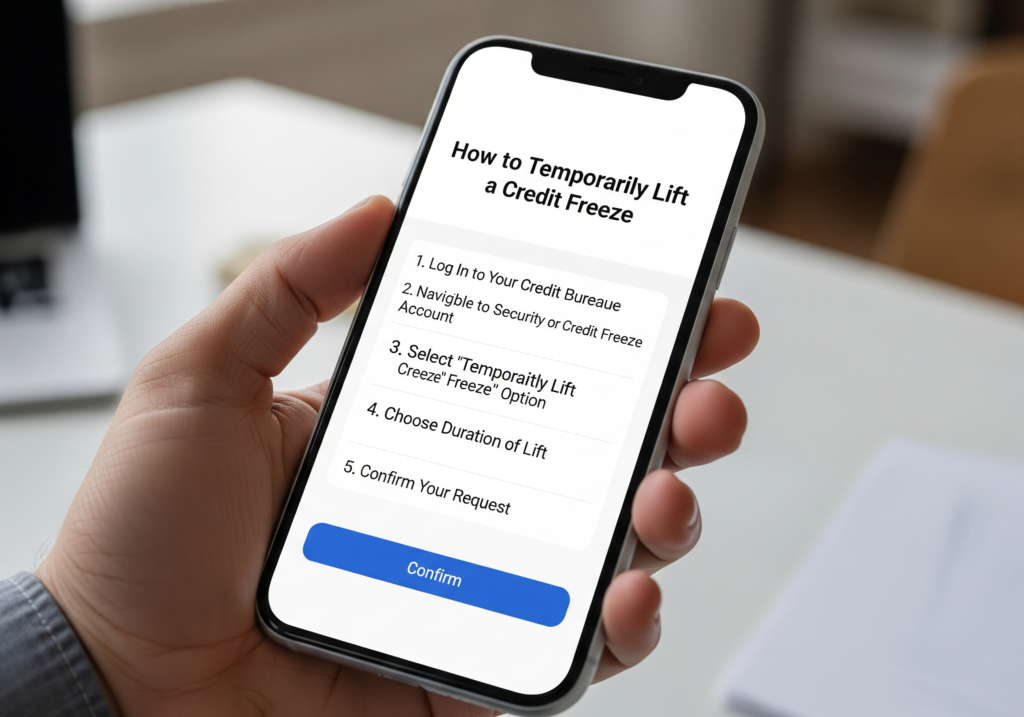
How to Temporarily Lift a Credit Freeze
If you want to apply for new credit, you need to lift the freeze.
This is sometimes called “thawing” your credit.
You can usually choose:
- Temporary lift
- Permanent removal
- Lift for one specific bureau
- Lift for a specific date range
- Lift for a specific creditor, depending on bureau options
The best option is usually a temporary lift.
Example:
You are applying for a car loan on June 10.
You can temporarily lift your freeze from June 9 to June 12.
After that, the freeze returns automatically.
Before applying, ask the lender:
“Which credit bureau do you check?”
If they say they only check Experian, you may only need to lift Experian.
If they are unsure, lift all three temporarily to avoid delays.
How Long Does It Take to Lift a Credit Freeze?
Online or phone requests are often fast, but you should not wait until the last second.
If you know you are applying for credit, lift the freeze before the application.
A practical rule:
Lift your credit freeze at least one day before applying for new credit.
This avoids unnecessary denial, delays, or confusion.
If the application is urgent, online lifting is usually the fastest method.
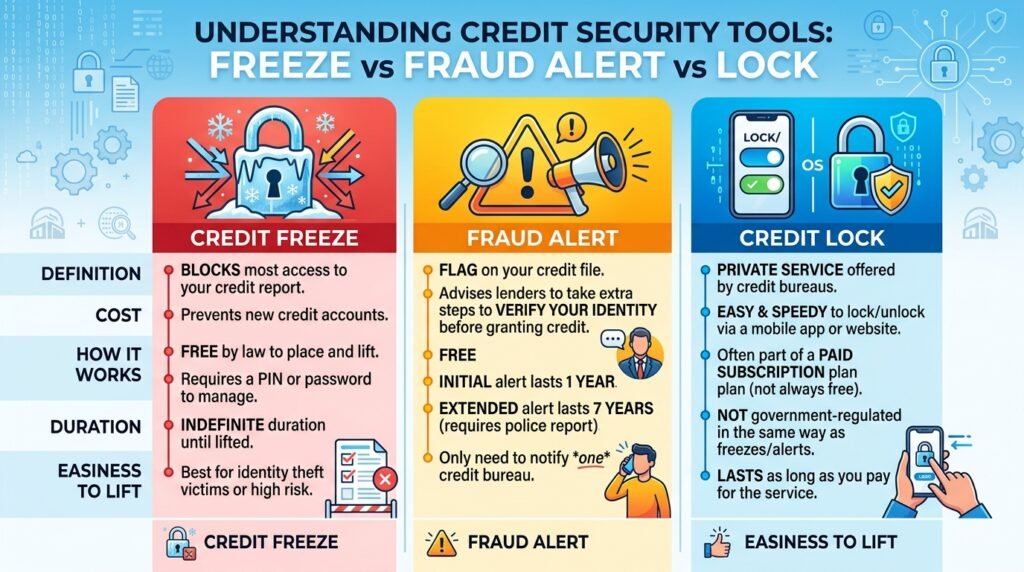
Credit Freeze vs Fraud Alert vs Credit Lock
People confuse these three terms.
They are related, but not the same.
| Tool | What It Does | Cost | Best For |
|---|---|---|---|
| Credit Freeze | Restricts access to your credit report | Free | Strong protection against new account fraud |
| Fraud Alert | Tells creditors to verify your identity before opening credit | Free | Suspected identity theft or extra caution |
| Credit Lock | Lets you lock/unlock report through bureau service | May be free or paid | Convenience, depending on service terms |
The FTC explains that a credit freeze restricts access to your credit report, while a fraud alert tells businesses to check with you before opening a new account.
Equifax also explains that a credit report lock and security freeze both prevent access to your report for opening new credit accounts, but they are not the same thing.
NerdWallet notes that credit locks can carry a monthly fee, while credit freeze options are free; freezes may also provide legal protections that locks do not.
For most people, a credit freeze is the cleaner starting point because it is free and legally protected.
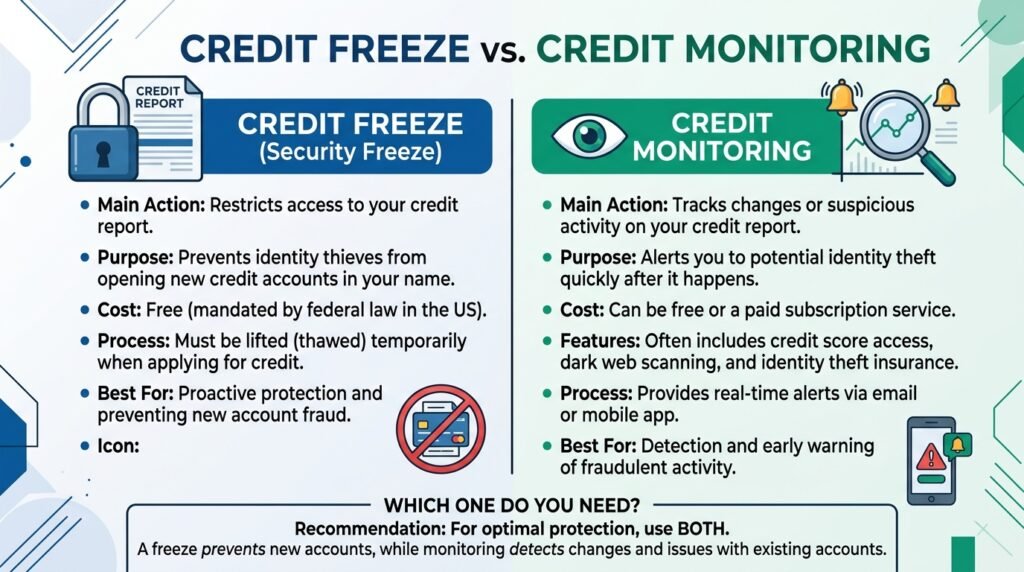
Credit Freeze vs Credit Monitoring
A credit freeze and credit monitoring are not the same.
A credit freeze helps block new credit accounts from being opened.
Credit monitoring alerts you when certain changes appear on your credit report.
Monitoring tells you something happened.
A freeze helps prevent some things from happening.
Both can be useful, but they serve different purposes.
If your data was exposed, freezing your credit is often stronger than only monitoring.
Monitoring is like a camera.
A freeze is like a locked door.
You may want both, but do not confuse them.
Does a Credit Freeze Stop Identity Theft Completely?
No.
A credit freeze helps prevent new credit accounts from being opened in your name, but it does not stop all identity theft.
It may not stop:
- Fraud on existing credit cards
- Bank account takeover
- Tax identity theft
- Medical identity theft
- Phone account fraud
- Email account hacking
- Social media account takeover
- Debit card fraud
- Password-based fraud
That is why you should also:
- Use strong passwords
- Turn on two-factor authentication
- Monitor bank accounts
- Check credit card statements
- Review credit reports
- Watch for strange mail
- Protect your Social Security number
- Avoid phishing links
- Use secure devices
A credit freeze is strong, but it is not complete protection by itself.
Should You Freeze Your Child’s Credit?
This can be a smart move.
Children are attractive targets for identity theft because their credit may go unchecked for years.
A thief could use a child’s personal information to open accounts, and the fraud might not be discovered until the child becomes older.
Parents or guardians can usually request a freeze for a minor’s credit file, but the process may require extra documentation.
Check each bureau’s instructions for minors.
This is not something every parent thinks about, which is exactly why it can be important.
Should You Freeze Credit for an Elderly Parent?
Possibly, especially if they are vulnerable to scams or no longer applying for new credit.
Older adults may be targeted by fraud, scams, and identity theft.
A credit freeze can reduce the chance of new fraudulent credit accounts being opened.
But you need proper authority and documentation if you are acting on someone else’s behalf.
Check each bureau’s process.
Do not attempt to manage another adult’s credit without legal permission.
Common Mistakes to Avoid
Mistake 1: Freezing Only One Credit Bureau
This is the biggest mistake.
Freeze Equifax, Experian, and TransUnion.
Mistake 2: Forgetting Your Login Details
You will need access later to lift the freeze.
Use a secure password manager or safe record system.
Mistake 3: Applying for Credit Without Lifting the Freeze
This can delay or block your application.
Lift the freeze before applying.
Mistake 4: Paying for Something That Should Be Free
Credit freezes are free.
Be careful not to confuse a freeze with paid monitoring or lock products.
Mistake 5: Thinking a Freeze Stops All Fraud
It does not.
Monitor existing accounts.
Mistake 6: Not Freezing After a Data Breach
If sensitive data may be exposed, freezing quickly can reduce risk.
Mistake 7: Forgetting to Refreeze After Applying
Use temporary lifts when possible so the freeze returns automatically.
Practical Scenario: Freezing Credit After a Data Breach
Suppose you receive a notice that your personal information may have been exposed.
Here is what to do:
- Freeze your credit at Equifax.
- Freeze your credit at Experian.
- Freeze your credit at TransUnion.
- Change passwords on important accounts.
- Turn on two-factor authentication.
- Review bank and credit card statements.
- Check your credit reports.
- Consider a fraud alert if you suspect identity theft.
- Watch for suspicious mail or account notices.
- Keep freeze login information safe.
This is practical protection.
Do not wait until a fraudulent account appears.
Practical Scenario: Applying for a Loan While Your Credit Is Frozen
Suppose your credit is frozen and you want to apply for an auto loan.
Do this:
- Ask the lender which bureau they use.
- Log in to that bureau’s freeze center.
- Temporarily lift the freeze.
- Choose a short date range.
- Submit the loan application.
- Confirm the lender completed the credit check.
- Let the freeze return automatically.
If the lender checks multiple bureaus, lift all three temporarily.
This keeps protection in place while allowing legitimate credit applications.
Step-by-Step Checklist: How to Freeze Your Credit Safely
Use this checklist.
Before Freezing
- Decide if you are applying for credit soon.
- Gather personal information.
- Create secure passwords.
- Prepare to freeze all three bureaus.
During the Freeze
- Freeze Equifax.
- Freeze Experian.
- Freeze TransUnion.
- Save confirmation details.
- Store login information securely.
After Freezing
- Monitor credit reports.
- Check bank and credit card accounts.
- Keep current cards active and paid.
- Lift freeze temporarily before new credit applications.
- Refreeze after applications if needed.
This is the simplest safe workflow.
Conclusion
You can freeze your credit without hurting your credit score.
That is the key point.
A credit freeze is free, does not lower your score, and does not stop you from using existing credit cards. It simply blocks most new creditors from accessing your credit report, which can help prevent criminals from opening new credit accounts in your name.
The right process is simple:
- Freeze your credit with Equifax.
- Freeze your credit with Experian.
- Freeze your credit with TransUnion.
- Save your login details securely.
- Monitor your accounts.
- Temporarily lift the freeze before applying for new credit.
- Let the freeze return after the application.
Do not let fear of damaging your score stop you.
A credit freeze is not a credit penalty. It is a protection tool.
Used correctly, it helps you protect your financial identity without hurting your credit score.
Frequently Asked Questions
Does freezing your credit hurt your credit score?
No. Freezing your credit does not hurt your credit score. A credit freeze restricts access to your credit report for new credit applications, but it does not change your payment history, credit utilization, or any other scoring factors.
Can I still use my credit cards after freezing my credit?
Yes. You can still use all your existing credit cards and loans after freezing your credit. A freeze only blocks new lenders from accessing your report — it has no effect on accounts you already have open.
Do I need to freeze my credit with all three bureaus?
Yes. You should freeze your credit separately with Equifax, Experian, and TransUnion. Freezing only one bureau leaves gaps because lenders may check any of the three — and a freeze at one bureau does not automatically apply to the others.
Is it free to freeze and unfreeze my credit?
Yes. Credit freezes are completely free to place and free to lift at all three bureaus. Be careful not to confuse a free credit freeze with paid credit monitoring services or credit lock products that charge a monthly fee.
Can I apply for a loan while my credit is frozen?
Yes, but you need to temporarily lift the freeze before the lender checks your credit. You can usually lift the freeze for a specific period of time online or by phone, and it will return automatically once that window expires.
How long should I keep my credit frozen?
You can keep your credit frozen for as long as you want — there is no expiration date. Many people keep it frozen permanently and only lift it temporarily when applying for new credit. This is considered one of the strongest ongoing protections against identity theft.
Is a credit freeze better than a fraud alert?
A credit freeze is stronger. It fully restricts access to your credit report so new accounts cannot be opened without your permission. A fraud alert simply tells creditors to take extra steps to verify your identity before approving credit. Both can help, but they work very differently.
Does a credit freeze stop all identity theft?
No. A credit freeze mainly helps prevent new credit accounts from being opened in your name. It does not protect your existing bank accounts, credit cards, passwords, or other personal information. You still need to monitor your accounts and practice strong password hygiene.

John F. Miller is a personal finance writer and the founder of MyCash Advice. He covers savings accounts, credit cards, budgeting strategies, and debt payoff methods. His mission is to make practical money advice accessible to everyone regardless of income level.