Does Canceling a No Annual Fee Credit Card Hurt Your Credit Score?
Introduction
Canceling a no annual fee credit card sounds harmless.
After all, if the card costs nothing to keep, why would closing it matter?
The answer is simple: yes, canceling a no annual fee credit card can hurt your credit score, but not always. The effect depends on your credit utilization, credit history, number of open accounts, and overall credit profile.
In many cases, keeping a no annual fee card open is smarter than canceling it, especially if the card has a long history or a high credit limit. Since it does not cost you an annual fee, the card may help your credit score by increasing your available credit and supporting your account history. But there are situations where closing the card still makes sense.
This article explains when canceling a no annual fee credit card can hurt your credit score, when it may not matter much, and what to do before you close the account. If you are still looking for the right card, see our full guide to the best no annual fee credit cards of 2026 to compare the top picks available right now.
Want to understand exactly how your credit score works? Read Your Score by Anthony Davenport, it breaks down
everything in plain English.
How Canceling a Credit Card Can Hurt Your Score
The biggest issue is credit utilization.
Credit utilization means how much of your available credit you are using. The Consumer Financial Protection Bureau explains that closing an existing credit card can increase your credit utilization ratio and lower your score.
For example, imagine you have two credit cards:
- Card A: $1,000 limit
- Card B: $1,000 limit
- Total available credit: $2,000
- Current balance: $500
Your utilization is:
$500 ÷ $2,000 = 25%
Now imagine you close Card B.
Your available credit drops to $1,000, but your balance is still $500.
Your new utilization becomes:
$500 ÷ $1,000 = 50%
That higher utilization can hurt your credit score.
This matters because “amounts owed,” which includes utilization-related factors, makes up 30% of a FICO Score. FICO also lists payment history, length of credit history, new credit, and credit mix as major score categories.

Does Closing the Card Remove Its History Immediately?
Not usually. A common fear is that closing an old card instantly erases the account from your credit history. That is not usually how it works.
The bigger short-term issue is usually utilization, not immediate deletion of history. Experian explains that closing a card can hurt your credit especially if it increases credit utilization, lowers average age of accounts, or limits credit mix.
So, if your no annual fee card is old and has a strong payment history, closing it may not erase its history immediately, but it can still weaken your profile over time. That is why older no-fee cards are often worth keeping open.
When You Should Usually Keep the Card Open
You should usually keep a no annual fee credit card open if:
- It has no annual fee
- It has a high credit limit
- It is one of your oldest accounts
- You are planning to apply for a loan soon
- You carry balances on other cards
- You want to keep your utilization low
- You can avoid overspending on it
Experian specifically notes that if there is no annual fee, keeping an unused card open can help you benefit from higher available credit and longer account history. A practical option is to keep the card open, use it occasionally for a small purchase, and pay it off in full.
For example, you could use it for:
- One small subscription
- Fuel once a month
- A small grocery purchase
- A recurring bill you already pay
Then set autopay to avoid missing payments.
When Canceling May Make Sense
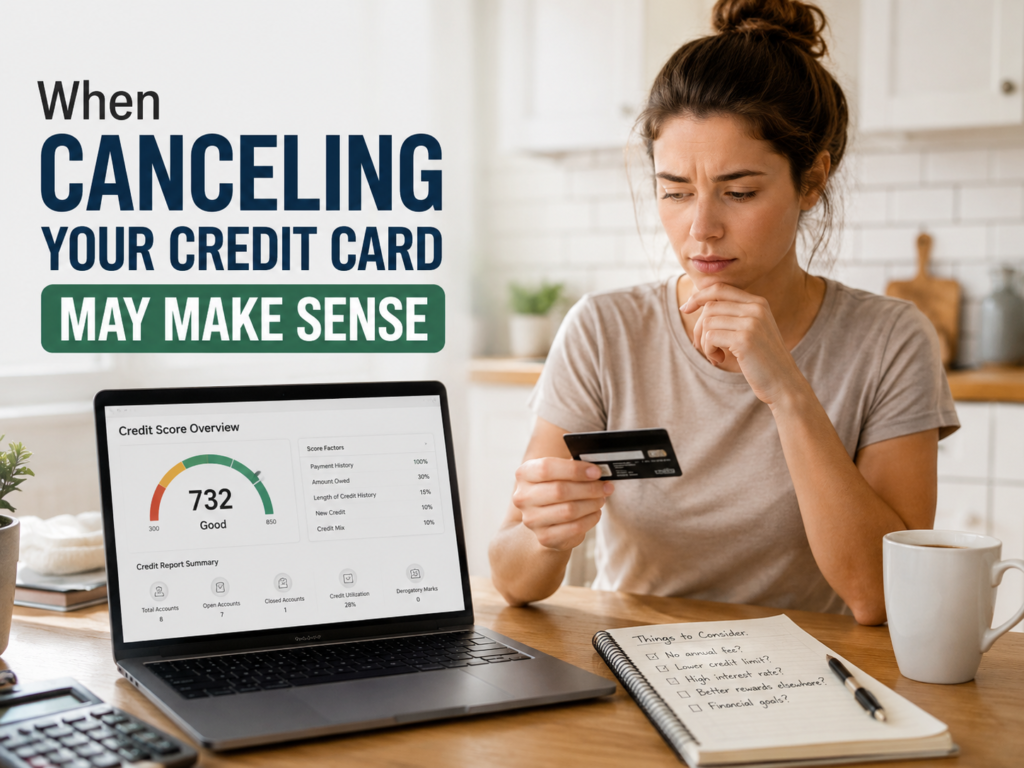
Canceling a no annual fee credit card may make sense if the card causes more harm than good.
Consider closing it if:
- It tempts you to overspend
- You struggle with debt
- The card has poor security or bad customer service
- You want to simplify your finances
- You are paying hidden fees or penalty fees
- You no longer trust yourself to keep it unused
Credit score optimization is not the only thing that matters. If a card keeps pushing you into debt, closing it may be the healthier financial move.
A slightly lower credit score is better than repeated overspending, missed payments, or growing high-interest debt.
What to Do Before Canceling the Card
Before canceling, take these steps.
1. Check Your Credit Utilization
Add up all your credit card balances.
Then add up all your credit limits.
Use this formula:
Total balances ÷ total credit limits = credit utilization
If canceling the card pushes your utilization much higher, reconsider closing it.
2. Pay Down Balances First
If you carry balances on other cards, pay them down before closing a card. This reduces the utilization impact.
3. Redeem Rewards
If the card has points, cash back, or rewards, redeem them before canceling.
4. Move Recurring Payments
Check whether subscriptions, bills, or memberships are charged to the card.
Move them to another payment method before closing. To learn how to stop leaving pay check to pay check read How to Stop Living Paycheck to Paycheck: 15 Budget Steps.
5. Ask for a Product Change Instead
If the issue is not the card itself, ask the issuer if there is another no-fee option. This may allow you to keep the account history without keeping the same card.
6. Avoid Closing Before a Loan Application
If you plan to apply for a mortgage, auto loan, or major credit soon, avoid unnecessary account changes before the application.
So, Should You Cancel a No Annual Fee Credit Card?
In most cases, do not cancel a no annual fee credit card unless you have a strong reason.
If it costs nothing, has a decent credit limit, and does not tempt you to overspend, keeping it open can help your credit profile.
The best approach is:
- Keep it open
- Use it occasionally
- Pay it off in full
- Keep utilization low
- Monitor the account for fraud
- Avoid unnecessary debt
But if the card makes it harder to control spending, closing it may be reasonable.
Your credit score matters, but your financial behavior matters more.
Before you cancel, it may be worth reviewing whether you have the right card in the first place. See our picks for the best no annual fee credit cards of 2026.
Conclusion
Canceling a no annual fee credit card can hurt your credit score, mainly by increasing your credit utilization and reducing your available credit.
If the card has no annual fee, a good credit limit, and a long history, keeping it open is often the smarter move.
But if the card encourages overspending or makes your finances harder to manage, closing it may still be the right decision.
The best choice is not just the one that protects your score. It is the one that protects your overall financial stability.
Frequently Asked Questions
Does canceling a no annual fee credit card always hurt your credit score?
No. It does not always hurt your credit score. The biggest risk is that closing the card can reduce your available credit and increase your credit utilization ratio — which can lower your score. The impact depends on how much other available credit you have.
Is it better to keep a no annual fee credit card open?
Usually, yes. If the card costs nothing and does not tempt you to overspend, keeping it open helps your credit utilization ratio and adds to your account history length — both of which positively affect your credit score.
Should I close a credit card I never use?
Not always. If it has no annual fee, consider keeping it open and using it occasionally for a small purchase to keep it active. However, if the card tempts you to overspend or causes confusion, closing it may be the smarter choice for your finances.
What should I do before closing a credit card?
Before closing any card, check your credit utilization, pay down existing balances, redeem any remaining rewards, move recurring payments to another card, and avoid closing it right before applying for a major loan or mortgage.

John F. Miller is a personal finance writer and the founder of MyCash Advice. He covers savings accounts, credit cards, budgeting strategies, and debt payoff methods. His mission is to make practical money advice accessible to everyone regardless of income level.