How Do I Downgrade My Credit Card to Avoid the Annual Fee?
Introduction
If your credit card annual fee is coming up and you no longer think the card is worth it, canceling may seem like the obvious move.
But canceling is not your only option.
In many cases, you may be able to downgrade your credit card to avoid the annual fee. This usually means switching your current card to another card from the same issuer with a lower annual fee or no annual fee.
This is called a product change.
A product change lets you swap an existing card for another card from the same issuer. NerdWallet explains that after a product change, the old card can no longer be used, but the credit history from the account typically remains on your credit report.
That is why downgrading can be better than canceling.
You may be able to:
- Avoid the annual fee
- Keep the account open
- Preserve account history
- Maintain available credit
- Avoid applying for a new card
- Avoid a hard inquiry in many cases
- Keep a relationship with the issuer
The goal is simple: keep the useful parts of the account and remove the fee.
Want the exact script to call your bank and downgrade your card without damaging your credit? I Will Teach
You To Be Rich by Ramit Sethi walks you through the entire conversation word for word including what to say when they push back.
What Does It Mean to Downgrade a Credit Card?
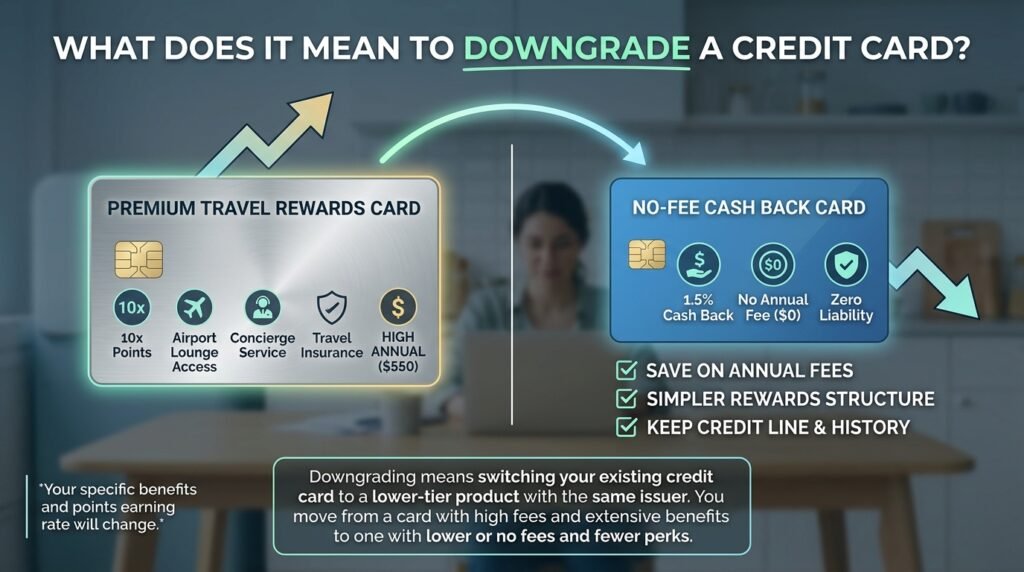
Downgrading a credit card means changing from your current card to a less expensive card within the same issuer’s card family.
For example:
- Premium travel card → no annual fee travel card
- Rewards card with annual fee → basic cash back card
- Mid-tier card → no annual fee version
- Points card → simpler no-fee card
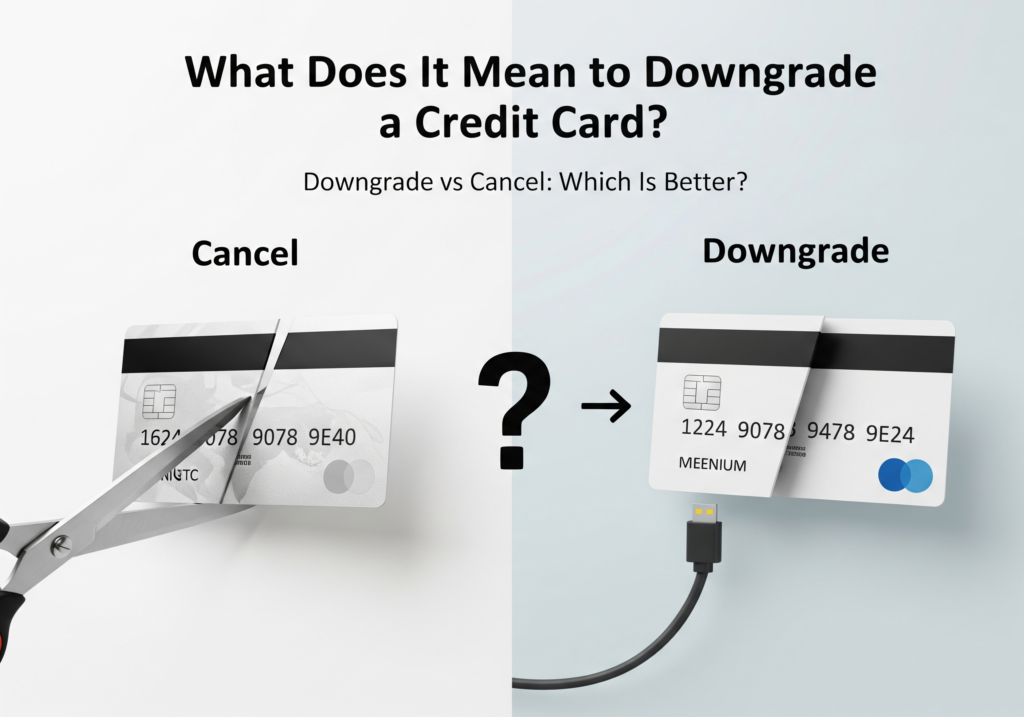
This is different from canceling.
When you cancel a card, the account closes.
When you downgrade, the account usually remains open, but the card product changes.
Bankrate notes that downgrading can help you save money without necessarily harming your credit score, because you keep the same account and the average account age should not be affected the way it might be with cancellation.
That does not mean every downgrade is perfect. You may lose benefits, rewards categories, travel perks, or future sign-up bonus eligibility.
But if the annual fee no longer makes sense, downgrading is often the cleaner move.
When Downgrading Makes Sense
Downgrading may be a good idea if:
- The annual fee is no longer worth it
- You are not using the card benefits
- You want to avoid canceling the account
- You want to keep your credit history
- You want to preserve your credit limit
- You do not want to apply for a new card
- You want a simpler no annual fee card
- You are trying to reduce expenses
- You are no longer traveling enough to justify a travel card
- You want to avoid paying for premium perks you do not use
Example:
You have a travel card with a $95 annual fee. You used to travel often, but this year you barely used the card’s benefits. Instead of canceling, you call the issuer and ask to switch to a no annual fee card in the same family.
That may let you keep the account open while avoiding the fee.
When Downgrading May Not Be the Best Move
Downgrading is not always the right choice.
Be careful if:
- You will lose valuable rewards
- You will lose travel credits you already use
- You may lose points if you downgrade incorrectly
- The downgrade blocks a future sign-up bonus
- The new card has weak benefits
- The issuer will not keep your credit limit
- The annual fee is still outweighed by benefits
- You have not asked for a retention offer first
Before downgrading, compare the card’s annual fee with the value you actually receive.
If the card costs $95 per year but gives you $250 in benefits you truly use, keeping it may make sense.
If the card costs $250 per year and you use almost none of the benefits, downgrading is probably worth exploring.
Step 1: Check When the Annual Fee Posts
Timing matters.
The best time to downgrade is usually:
- Before the annual fee posts
- Soon after the annual fee appears
- Before the payment due date
- Before you cancel the card
Do not ignore the fee for months and then ask for a refund later.
Policies vary by issuer. Some may refund the fee if you downgrade or cancel within a certain window after the annual fee posts. Others may not.
Your first job is to check:
- When the annual fee posted
- How much it is
- When payment is due
- Whether you have used benefits tied to the fee
- Whether your issuer offers fee refunds after downgrade
Call as soon as you notice the fee.
Step 2: Check Whether Your Card Has a No-Annual-Fee Downgrade Path
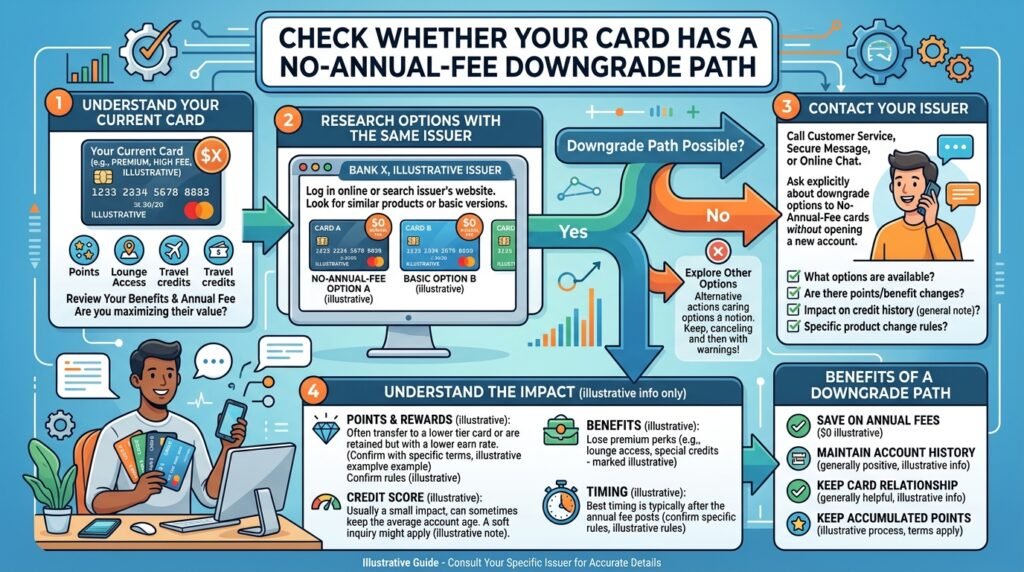
Not every card can be downgraded to every other card.
Usually, you can only product change within the same issuer and often within the same card family.
For example, a travel rewards card may downgrade to a no annual fee travel card from the same issuer. A cash back card may downgrade to a simpler cash back card.
Before calling, search the issuer’s website for no annual fee options.
Look for:
- No annual fee card from the same issuer
- Similar rewards currency
- Same card family
- Same network, if relevant
- Card with benefits you can still use
Bankrate’s no-annual-fee card coverage notes that some issuers allow rewards to be combined between cards in the same issuer ecosystem, which can make downgrading or pairing cards more useful.
Your goal is to avoid downgrading blindly.
Know the card you want before you call.
Step 3: Use or Protect Your Rewards Before Downgrading
This is critical.
Before you downgrade, check what happens to your rewards.
Ask:
- Will my points transfer to the new card?
- Will I lose unused points?
- Will my points become less valuable?
- Will my cash back remain?
- Will travel credits disappear?
- Will I lose access to transfer partners?
- Will any pending rewards post later?
- Should I redeem rewards before downgrading?
Some premium cards give rewards more value when redeemed through travel portals, partners, or statement credits. A downgrade may reduce those options.
Do not downgrade until you understand the reward consequences.
If you are unsure, ask the issuer directly:
“If I product change this card, what happens to my current points, miles, cash back, credits, and benefits?”
Get the answer before approving the downgrade.
Step 4: Ask for a Retention Offer First
Before downgrading, ask whether the issuer can offset the annual fee.
A retention offer may include:
- Annual fee waiver
- Statement credit
- Bonus points
- Bonus miles
- Cash back offer
- Spending-based reward
- Reduced annual fee
Use this script:
“I’m reviewing whether to keep this card because the annual fee is coming up. Are there any retention offers, statement credits, bonus points, or fee waivers available on my account?”
If the offer is strong, keeping the card may make sense.
If there is no offer, move to the downgrade request.
For the full phone script, read How do I get an annual fee waived on my credit card?.
Step 5: Call the Issuer and Ask for a Product Change
Call the number on the back of your card.
Say this:
“Hi, I’m calling because I want to avoid the annual fee on this card. I do not want to close the account if I can avoid it. Can I downgrade or product change this card to a no annual fee option?”
If the representative says yes, ask:
“Which no annual fee cards am I eligible to switch to?”
Then ask:
“Will my account number, credit limit, credit history, rewards, and current balance stay the same after the product change?”
Do not approve the change until you understand the details.
Step 6: Confirm Whether There Will Be a Hard Inquiry
One benefit of downgrading is that it often does not require a new credit application.
But do not assume.
Ask directly:
“Will this product change require a hard credit inquiry?”
If the answer is yes, pause and think carefully.
A downgrade usually should not need the same process as applying for a new card, but policies vary.
The point of downgrading is to avoid unnecessary credit disruption.
Step 7: Confirm What Happens to Your Credit Limit
Ask:
“Will my credit limit stay the same after the downgrade?”
This matters because credit utilization affects your credit score.
If your limit drops significantly, your utilization could rise.
Example:
Before downgrade:
- Credit limit: $10,000
- Balance: $1,500
- Utilization: 15%
After downgrade with lower limit:
- Credit limit: $3,000
- Balance: $1,500
- Utilization: 50%
That could hurt your credit profile.
If the issuer says your limit may change, ask for details before proceeding.
If you are deciding between downgrade and cancellation, read Does canceling a no annual fee credit card hurt your credit score?.
Step 8: Confirm What Happens to the Annual Fee
This is the main reason you called.
Ask:
“If I downgrade today, will the annual fee be removed, refunded, or prorated?”
You need a clear answer.
Possible outcomes:
- Full fee reversal
- Partial refund
- Statement credit
- No refund
- Fee avoided next year only
- Fee remains because you waited too long
Do not assume the downgrade automatically removes the current fee.
If the fee already posted, the timing matters.
Ask before approving the product change.
Step 9: Confirm What Benefits You Lose
Downgrading usually means losing premium benefits.
You may lose:
- Travel credits
- Lounge access
- Higher reward rates
- Purchase protections
- Travel insurance
- Transfer partners
- Bonus categories
- Statement credits
- Elite status benefits
- Anniversary bonuses
- Free checked bags
- Hotel or airline perks
Ask:
“Which benefits will I lose immediately after downgrading?”
Also ask:
“Are there any benefits I have already used that could affect my fee refund?”
This helps avoid surprises.
Step 10: Move Recurring Payments Before the Change
Sometimes your card number may stay the same. Sometimes it may change.
Before or immediately after downgrading, check recurring payments.
Look for:
- Streaming services
- Phone bill
- Internet
- Insurance
- Utilities
- Subscriptions
- App payments
- Memberships
If your card number changes and you do not update payment details, you could miss payments.
Make a list before calling.
After the downgrade, update anything necessary.
Step 11: Get Confirmation
Before ending the call, ask the representative to confirm:
- New card name
- New annual fee
- Whether the old fee is refunded
- Whether your credit limit changes
- Whether rewards transfer
- Whether a hard inquiry occurs
- When the change takes effect
- Whether a new card will be mailed
- Whether your account number changes
Then save the confirmation.
If possible, ask for confirmation by email or secure message.
At minimum, write down:
- Date of call
- Representative name or ID
- Summary of what was agreed
- Expected timeline
Do not rely on memory.
Step 12: Check Your Account After the Downgrade
After the product change, log in and verify:
- Annual fee status
- New card name
- Credit limit
- Rewards balance
- Statement credits
- Payment due date
- Autopay settings
- Recurring charges
- Available benefits
Do this within a few days and again after the next statement closes.
If something looks wrong, contact the issuer immediately.
What to Say If the Issuer Says No
If the issuer says you cannot downgrade, ask:
“Are there any other no annual fee products available for this account?”
If still no:
“Are there any retention offers that can offset the annual fee?”
If still no:
“If I close the account, will the annual fee be refunded or prorated?”
If the answer is still bad, you have three options:
- Keep the card if the benefits outweigh the fee.
- Cancel if the card is not worth it.
- Wait and call again later if the fee has not posted yet.
Do not make an emotional decision. Compare the numbers.
Downgrade vs Cancel: Which Is Better?
Downgrading is usually better if:
- You want to avoid the annual fee
- You want to keep the account open
- You want to preserve history
- You want to maintain available credit
- You do not need the premium benefits
- You can use the no-fee version responsibly
Canceling may be better if:
- The issuer offers no useful downgrade
- The card tempts you to overspend
- You have too many cards
- You cannot manage the account
- The card has poor service or fraud concerns
- You want a clean break from credit card debt
A downgrade is not always possible, but it should usually be explored before canceling.
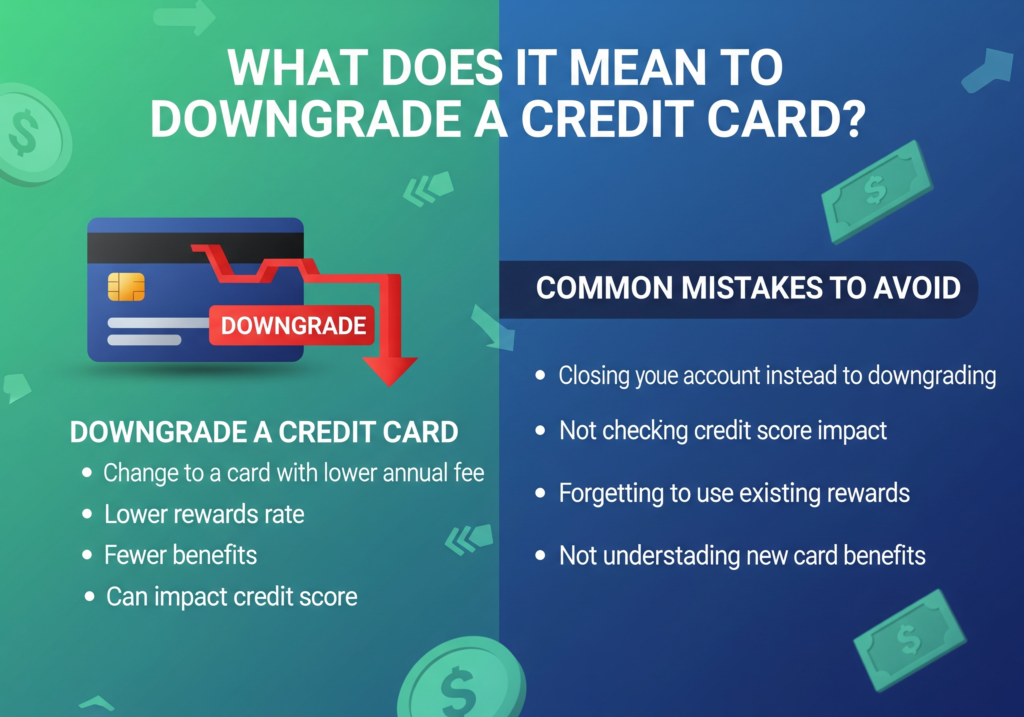
Common Mistakes to Avoid
Mistake 1: Canceling Before Asking About Downgrade
This is the biggest error. Always ask about product change first.
Mistake 2: Waiting Too Long After the Annual Fee Posts
Call quickly.
Mistake 3: Forgetting About Rewards
Some rewards may lose value or disappear.
Mistake 4: Not Asking About Credit Limit Changes
A lower limit can affect utilization.
Mistake 5: Accepting a Weak Retention Offer That Requires Overspending
Do not spend money you would not normally spend just to justify keeping a card.
Mistake 6: Ignoring Recurring Payments
Update subscriptions and bills after the change.
Mistake 7: Downgrading Without Knowing the New Card
Know what you are switching to.
Conclusion
To downgrade your credit card to avoid the annual fee, call your issuer and ask for a product change to a no-annual-fee card.
Do not cancel first.
Ask about retention offers, fee refunds, rewards, credit limit changes, hard inquiries, and benefit losses before making a decision.
A downgrade can be a smart move because it may let you avoid the annual fee while keeping the account open. But it must be done carefully.
The best sequence is:
- Check when the fee posts.
- Review the card’s value.
- Ask for a retention offer.
- Ask for a no-fee product change.
- Confirm rewards, credit limit, and fee refund details.
- Update recurring payments.
- Check the account after the downgrade.
If the card is no longer worth paying for, downgrading may be the cleanest way to keep your credit profile intact while removing an unnecessary cost.
Want the exact script to call your bank and downgrade your card without damaging your credit? I Will Teach
You To Be Rich by Ramit Sethi walks you through the entire conversation word for word including what to say when they push back.
Frequently Asked Questions
Can I downgrade my credit card to avoid the annual fee?
Yes, if your issuer allows product changes and has an eligible lower-fee or no-annual-fee card available. Not all issuers offer this option, and not all cards can be downgraded. You need to call and ask specifically about available product change options.
Does downgrading a credit card hurt your credit score?
Usually, downgrading is less harmful than canceling because the account often stays open and your available credit is preserved. However, confirm with your issuer whether your credit limit will change and whether a hard inquiry is required to process the downgrade.
Will I lose my rewards if I downgrade?
Possibly. It depends entirely on the issuer and the card you are downgrading to. Always ask what happens to your accumulated points, miles, cash back, statement credits, and card benefits before confirming the downgrade. Redeem anything you can before making the change.
When should I downgrade my credit card?
The best time to call is before the annual fee posts to your statement or within a few days of it appearing. Ask the representative whether the fee can be refunded, waived, or prorated if the downgrade is processed after the fee has already been charged.
Should I ask for a retention offer before downgrading?
Yes. Always ask for a retention offer first. The issuer may offer bonus points, a statement credit, or a full fee waiver to keep you on the current card. If the retention offer does not justify keeping the card, then ask about downgrading to a no-annual-fee version.

John F. Miller is a personal finance writer and the founder of MyCash Advice. He covers savings accounts, credit cards, budgeting strategies, and debt payoff methods. His mission is to make practical money advice accessible to everyone regardless of income level.