Can I Have Multiple No Annual Fee Credit Cards?
Introduction
Yes, you can have multiple no annual fee credit cards.
There is no rule that says you can only have one. In fact, many people keep several no annual fee cards open because they do not cost anything to hold and may help with credit utilization.
But this does not mean everyone should rush to open more cards.
Multiple no annual fee credit cards can be useful if you manage them well. They can increase your total available credit, help keep your utilization lower, and give you backup payment options. But they can also become a problem if they tempt you to overspend, make payments harder to track, or lead to too many credit applications in a short period.
The smart answer is this:
You can have multiple no annual fee credit cards, but only if each card has a clear purpose and you can pay every balance on time.
Why People Keep Multiple No Annual Fee Credit Cards
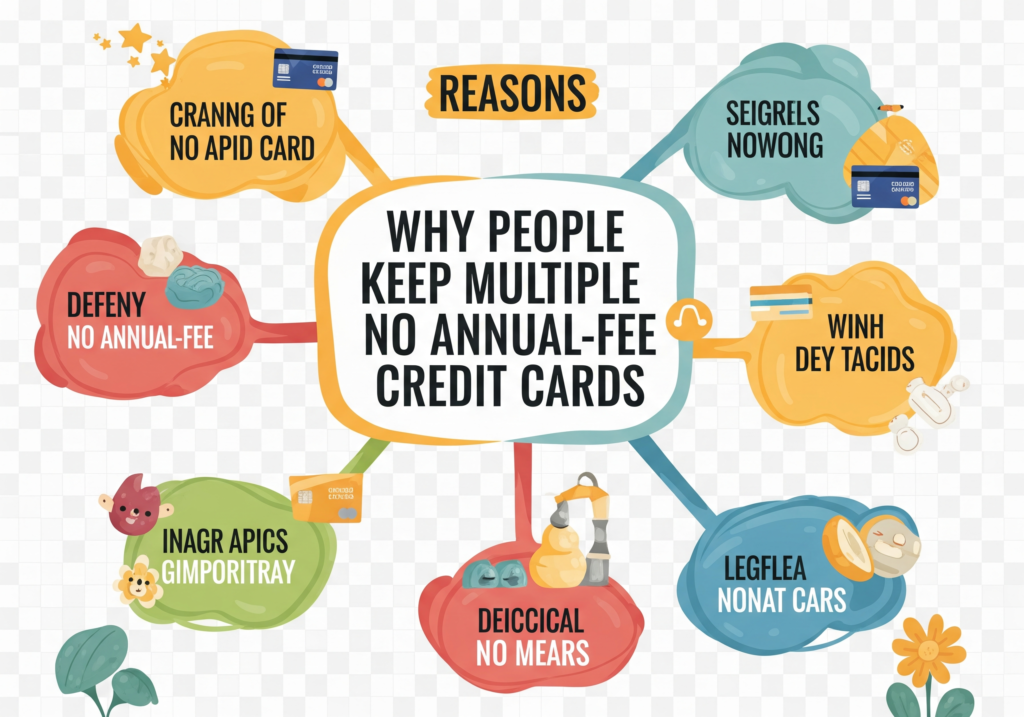
No annual fee cards are attractive because they do not charge you just for keeping the account open.
That means they can be useful for:
- Building credit history
- Increasing available credit
- Separating spending categories
- Keeping backup cards
- Earning rewards without paying a yearly fee
- Maintaining older accounts
- Lowering credit utilization
For example, you may use one card for groceries, one for gas, and one as a backup. Or you may keep an old no annual fee card open because it supports your credit history.
Experian notes that additional cards can increase total available credit, which may lower your credit utilization and potentially help your scores if managed responsibly. It also notes that many experts recommend keeping utilization below 30%, while high credit score achievers often keep it below 10%.
So multiple cards can help, but only if your spending does not rise with your credit limits.
That is the trap.
More available credit is useful. More debt is not.
How Multiple Cards Can Help Your Credit Score
The biggest potential benefit is lower credit utilization.
Credit utilization means how much of your available credit you are using.
Example:
You have one credit card:
- Credit limit: $1,000
- Balance: $400
Your utilization is:
$400 ÷ $1,000 = 40%
Now imagine you have three cards:
- Card 1 limit: $1,000
- Card 2 limit: $1,000
- Card 3 limit: $1,000
- Total available credit: $3,000
- Total balance: $400
Your utilization becomes:
$400 ÷ $3,000 = 13.3%
You owe the same $400, but your utilization is lower because your total available credit is higher.
That can help because “amounts owed,” which includes utilization-related factors, makes up 30% of a FICO Score. FICO also lists payment history, length of credit history, credit mix, and new credit as other major scoring categories.
But do not misunderstand this.
Opening multiple cards does not automatically improve your score. If more cards lead to more spending, your score and finances can suffer.
The Risk: Too Many Applications Too Fast
The main short-term risk is applying for too many cards quickly.
When you apply for a credit card, the lender usually performs a hard inquiry. The CFPB explains that hard inquiries can affect your score because many scoring models consider how recently and how frequently you apply for credit.
Credit card applications are different from some loan-shopping situations. For credit cards, multiple applications usually create multiple hard inquiries. Capital One explains that applying for multiple credit cards in a short period can lead to multiple hard inquiries, which could hurt your credit scores more than a single inquiry.
So, if you want multiple no annual fee credit cards, do not apply for five in one week.
A safer approach is to space applications apart and only apply when you have a clear reason.
How Many No Annual Fee Credit Cards Is Too Many?
There is no perfect number.
For one person, two cards may be enough. Another person may handle five responsibly. The issue is not only the number of cards. The issue is whether you can manage them properly.
You may have too many cards if:
- You forget payment due dates
- You carry balances
- You apply for cards just because they are free
- You use credit cards to cover income gaps
- You lose track of spending
- You feel tempted by available credit
- You are paying interest often
- You are opening cards before applying for a mortgage or auto loan
You may be managing multiple cards well if:
- You pay every card on time
- You pay balances in full
- You keep utilization low
- You monitor every account
- You avoid unnecessary applications
- Each card has a purpose
- You do not spend more because you have more credit
The best number is the number you can control without stress.
Should Beginners Have Multiple No Annual Fee Credit Cards?
Beginners should be careful.
If you are new to credit, start with one card. Learn how billing cycles, due dates, minimum payments, statement balances, autopay, utilization, and interest work first.
Once you can manage one card responsibly for several months, you may consider adding another card if it has a clear purpose.
A beginner-friendly progression may look like this:
- Start with one no annual fee card.
- Use it for small planned purchases.
- Pay the balance in full every month.
- Keep utilization low.
- After several months, consider a second card if needed.
- Avoid opening cards just because you qualify.
A credit card is not extra income. It is a payment tool.
If you treat multiple cards like extra money, they will hurt you.
When Multiple No Annual Fee Cards Make Sense
Having multiple no annual fee credit cards can make sense if you are organized and strategic.
Good reasons include:
1. You Want to Lower Utilization
More available credit can lower your utilization if your balances stay the same.
2. You Want Backup Payment Options
If one card is declined, frozen, lost, or compromised, another card can help.
3. You Want to Separate Spending
You may use one card for groceries, one for bills, and one for business-related purchases.
4. You Want to Keep Older Accounts Open
An old no annual fee card may support your credit history without costing you an annual fee.
5. You Want Rewards Without Fees
Some no annual fee cards offer cash back or points. If you pay in full, rewards can be useful.
But rewards should never justify overspending.
If you spend more to earn rewards, you are losing.
When Multiple Cards Are a Bad Idea
Multiple no annual fee cards are a bad idea if they create confusion or debt.
Avoid opening more cards if:
- You already miss payments
- You carry credit card balances
- You are living paycheck to paycheck
- You are trying to control impulse spending
- You do not track expenses
- You are applying for major credit soon
- You only want another card for shopping
- You do not understand interest charges
If credit cards make your money harder to control, the problem is not the card’s annual fee.
The problem is behavior.
If your spending already feels hard to manage, start with this budgeting for beginners guide before opening more credit cards.
How to Manage Multiple No Annual Fee Credit Cards
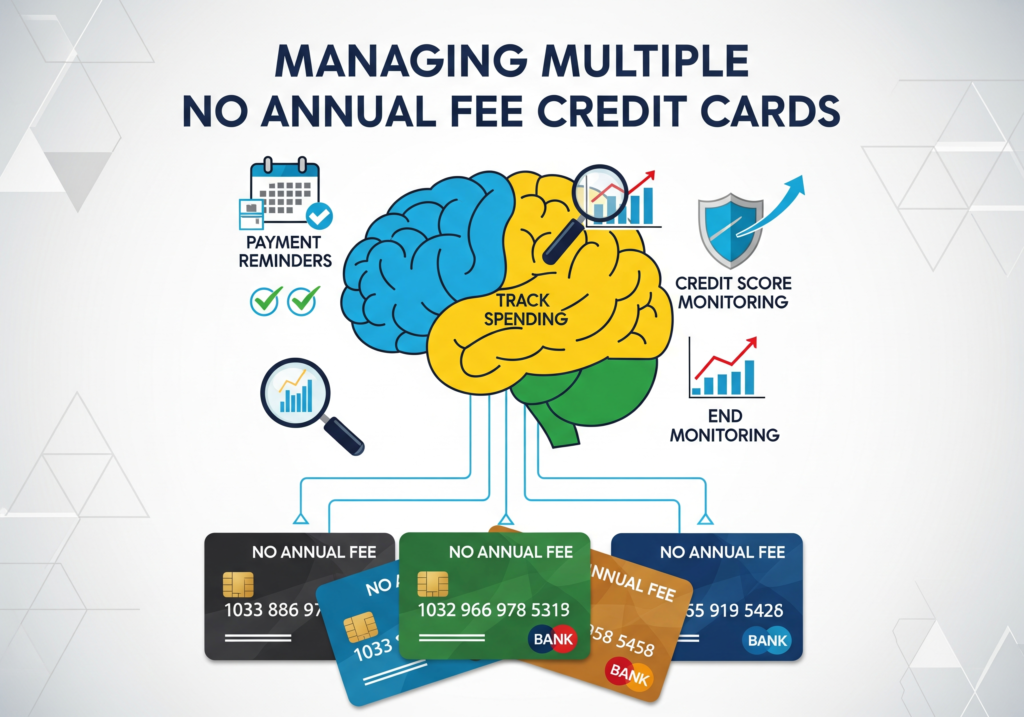
If you decide to keep several cards, use a system.
1. Set Autopay
At minimum, set autopay for the minimum payment.
Better: set autopay for the full statement balance if you can.
This helps prevent missed payments.
2. Keep a Payment Calendar
Write down every card’s due date.
Use a phone calendar, budgeting app, spreadsheet, or notebook.
3. Use Each Card for a Specific Purpose
Example:
- Card 1: groceries
- Card 2: gas or transport
- Card 3: small recurring bill
- Card 4: backup only
Purpose prevents random spending.
4. Keep Utilization Low
Try to keep balances low compared with credit limits. A low balance is safer than relying on available credit.
5. Use Old Cards Occasionally
If you never use a card, the issuer may reduce the limit or close the account for inactivity. Use it occasionally for a small purchase, then pay it off.
6. Monitor for Fraud
Unused cards can still be compromised.
Check every account at least monthly.
7. Avoid Carrying Balances
No annual fee does not mean no interest. If you carry a balance, interest can still be expensive.
Should You Close Extra No Annual Fee Cards?
Not automatically.
If a card has no annual fee, a long history, and a good limit, keeping it open may help your credit profile.
But closing may make sense if:
- The card tempts you to overspend
- You cannot track the account safely
- You have too many cards to manage
- You are simplifying after debt problems
- The issuer has poor service or security concerns
Before closing, check your utilization.
If closing the card reduces your available credit significantly, your utilization may rise.
For more detail, read Does canceling a no annual fee credit card hurt your credit score?.
Best Rule for Beginners
Use this rule:
Have only as many no annual fee credit cards as you can pay on time, monitor monthly, and use without increasing your spending.
For many beginners, that may be one or two cards.
For organized users, it may be more.
But if a card creates debt, anxiety, or confusion, it is not helping you.
Conclusion
You can have multiple no annual fee credit cards, and they can be useful when managed well.
They may help lower utilization, preserve credit history, provide backup payment options, and organize spending. But they can also create problems if they lead to overspending, missed payments, hard inquiries, or account confusion.
The best approach is simple:
Start with one card. Master it. Add another only when there is a clear purpose. Pay balances in full. Keep utilization low. Monitor every account.
Multiple no annual fee credit cards are not dangerous by themselves.
Poor management is the danger.
Want to learn exactly how to manage multiple credit cards without going into debt? I Will Teach You To Be Rich
by Ramit Sethi covers this in detail — written for beginners in plain English.
Frequently Asked Questions
Can I have more than one no annual fee credit card?
Yes. You can have more than one no annual fee credit card as long as you qualify and can manage them responsibly. Since there is no annual fee, the only cost is your time and attention to keep up with payments.
Do multiple no annual fee credit cards help my credit score?
They can help if they increase your total available credit and keep your credit utilization low. However, they can hurt your score if they lead to missed payments, growing debt, or too many hard inquiries in a short period of time.
How many no annual fee credit cards should a beginner have?
Most beginners should start with one card. Focus on learning how to manage payments on time, keep balances low, and understand your utilization ratio. Once you are comfortable, a second card may make sense to increase available credit.
Is it bad to apply for several no annual fee cards at once?
Yes, it can be risky. Each application triggers a hard inquiry on your credit report. Multiple hard inquiries in a short period can temporarily lower your credit score and signal to lenders that you may be in financial trouble.
Should I keep no annual fee cards open even if I do not use them?
Usually, yes — as long as they do not tempt you to overspend. Use them occasionally for a small purchase to keep the account active and reduce the risk of the issuer closing it due to inactivity.

John F. Miller is a personal finance writer and the founder of MyCash Advice. He covers savings accounts, credit cards, budgeting strategies, and debt payoff methods. His mission is to make practical money advice accessible to everyone regardless of income level.